

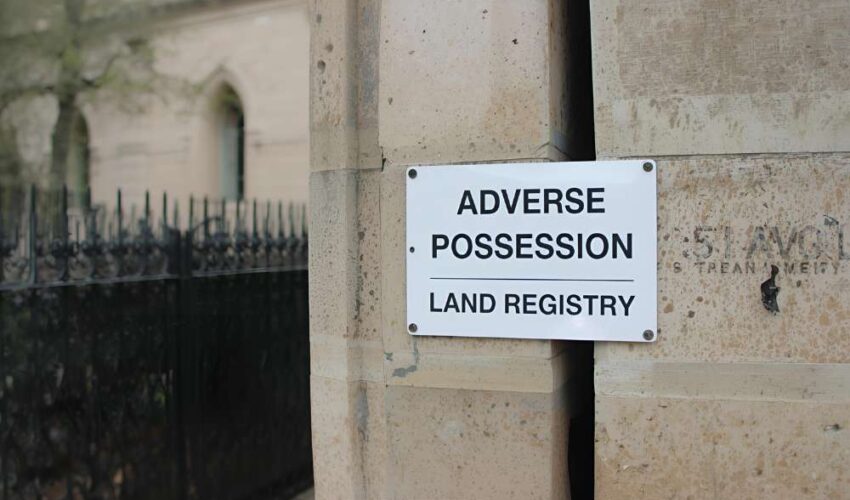
The concept of adverse possession, often sensationally dubbed ‘squatters’ rights’, conjures images of individuals illegally occupying property and, over time, acquiring legal ownership. While this broad understanding holds a kernel of truth, the reality, particularly concerning registered land in England and Wales, is far more nuanced and considerably more challenging for the aspiring ‘squatter’. The advent of the Land Registration Act 2002 fundamentally reformed this area of law, tilting the balance significantly in favour of the registered proprietor.
At Blackstone Solicitors, a leading law firm with extensive experience in property litigation across England and Wales, we frequently encounter cases involving adverse possession, both for landowners seeking to protect their title and for individuals exploring potential claims. Understanding the precise legal framework governing adverse possession of registered land is crucial for anyone involved in property matters. This article will demystify the process, explain the stringent requirements, and highlight the critical differences introduced by the 2002 Act.
Free Initial Telephone Discussion
For a free initial discussion with a member of our New Enquiries Team, get in touch with us today. We are experienced in dealing with all the legal aspects of adverse possession, and once instructed, we will review your situation and discuss the options open to you in a clear and approachable manner. Early expert legal assistance can help ensure you are on the best possible footing from the start and also avoid the stress of dealing with these issues on your own. Simply call us on 0345 901 0445 or click here to make a free enquiry and a member of the team will get back to you.
The Landscape Before the Land Registration Act 2002
To appreciate the current position, it’s helpful to briefly understand the law as it stood prior to 13 October 2003, the date the Land Registration Act 2002 (LRA 2002) came into force.
Under the Limitation Act 1980, a paper owner’s right to recover possession of land was ‘barred’ after 12 years of continuous adverse possession. This applied to both registered and unregistered land. For registered land, once the 12-year period expired, the squatter could then apply to the Land Registry to be registered as the new proprietor. Critically, the registered owner’s title was effectively extinguished by the passage of time and the squatter’s continuous possession. There was no formal notification process to the registered proprietor at the point of application, making it possible for a squatter to gain title without the owner’s direct knowledge during the process of adverse possession itself.
This earlier regime was often criticised for undermining the principle of title registration and for potentially allowing landowners to lose their property without sufficient opportunity to intervene. The LRA 2002 was enacted to address these concerns and to ensure that the Land Register became a more accurate and definitive record of ownership.
The Fundamental Requirements for Adverse Possession (Pre-Application)
Despite the significant procedural changes introduced by the LRA 2002 for registered land, the underlying common law definition of what constitutes “adverse possession” itself largely remains. For any claim to even be considered, the applicant (the squatter) must demonstrate:
- Factual Possession: The squatter must have actual, physical control over the land. This means dealing with the land as an occupying owner might, such as enclosing it, cultivating it, building on it, or otherwise exercising exclusive control over it. The acts of possession must be clear and unequivocal, demonstrating an intention to exclude the paper owner and the rest of the world. Sporadic or trivial acts are insufficient.
- Intention to Possess (Animus Possidendi): Beyond physical control, the squatter must have the intention to possess the land to the exclusion of all others, including the paper owner. This does not mean an intention to own or acquire title, but merely an intention to exercise exclusive control for the time being. This intention is usually inferred from the squatter’s overt acts of possession. Crucially, any acknowledgement of the paper owner’s title (e.g., asking for permission to use the land) will negate the required intention.
- Adverse Possession (Without Permission): The possession must be without the consent or permission of the paper owner. If there is a licence, tenancy, or any form of express or implied permission, the possession is not ‘adverse’ and cannot form the basis of a claim.
- Open and Notorious Possession: The possession must not be secret or hidden. The acts of possession must be sufficiently obvious that a reasonably diligent paper owner, inspecting their land, would be aware that someone else was in possession.
These four elements must be present concurrently and continuously for the relevant statutory period.
The Key Changes under the Land Registration Act 2002 (for Registered Land)
The LRA 2002 introduced a dramatically different procedure for claiming adverse possession over registered land. The 12-year limitation period no longer directly extinguishes the registered proprietor’s title. Instead, a squatter now has a right to apply to the Land Registry to be registered as the new proprietor after a specified period of adverse possession.
Here’s how the process generally works under the LRA 2002:
- 10 Years of Adverse Possession: The squatter must have been in continuous adverse possession of the registered land for a minimum period of 10 years immediately preceding the date of their application to the Land Registry. This 10-year period must satisfy all the common law requirements outlined above (factual possession, intention, adverse, open).
- Application to the Land Registry (Form ADV1): Once the 10-year period is complete, the squatter can submit an application to the Land Registry on Form ADV1. This application must include a statutory declaration outlining the details of their adverse possession, including when and how they took possession, the acts of control they have exercised, and how they meet the necessary criteria. Accurate plans of the land claimed are also essential.
- Land Registry Notification: This is the most significant change. Upon receiving a valid application, the Land Registry is legally obliged to notify the following parties:
- The registered proprietor of the land.
- The registered chargee (e.g., the mortgage lender).
- Any other person who appears to the registrar to have an interest in the land affected by the application.
This notification gives the registered proprietor and other interested parties a clear opportunity to object to the application.
- Opportunity to Object (65 Business Days): The notified parties are given a period of 65 business days (approximately three months) from the date of the notice to object to the squatter’s application.
- Outcomes of Notification:
- No Objection: If no objection is received from any of the notified parties within the 65-business-day period, the squatter will be registered as the new proprietor of the land. This is the simplest and most favourable outcome for the squatter.
- Objection Received: If an objection is received from the registered proprietor or another notified party, the squatter’s application will almost certainly be rejected by the Land Registry, unless the squatter can meet one of three very specific and narrow statutory conditions.
The Three Exceptions to Defeat an Objection
The LRA 2002 makes it very difficult for a squatter to succeed if the registered proprietor objects. The squatter’s application will only proceed if they can demonstrate that one of the following three conditions applies:
- Estoppel (Unconscionable to Dispossess):
- This condition applies where it would be “unconscionable because of an equity by estoppel” for the registered proprietor to seek to dispossess the applicant.
- This typically arises where the squatter has been led to believe, by the registered proprietor’s words or conduct, that they owned the land, and in reliance on that belief, the squatter has acted to their detriment (e.g., spent money on improvements).
- For example, if a landowner mistakenly tells their neighbour that a piece of land is theirs, and the neighbour then builds a garage on it, it might be unconscionable for the landowner to then object to the adverse possession claim.
- Other Right to the Land:
- This applies where the applicant is for some “other reason entitled to be registered as proprietor of the estate.”
- This is a very narrow exception and might apply in situations where, for example, the squatter has a valid contract to purchase the land, or is entitled to the land under a will or intestacy, but has not yet been registered. It is not about the adverse possession itself but about some underlying, pre-existing right to the land.
- Boundary Disputes (Adjacent Land and Reasonable Belief):
This is arguably the most common and practically relevant exception. It applies when the applicant is claiming a piece of land that is adjacent to land already owned by the applicant, and:
- For at least 10 years of the adverse possession, the applicant (or a predecessor in title) reasonably believed that the land belonged to them.
- The exact line of the boundary between the two properties has not been determined by the Land Registry under specific rules (which is often the case).
This exception is designed to resolve long-standing boundary discrepancies where one neighbour has genuinely believed a piece of land was theirs and acted accordingly, only to find the paper title is with their neighbour. The element of “reasonable belief” is subjective but must be objectively justifiable.
If none of these three exceptions apply, and the registered proprietor objects, the squatter’s application will be rejected, and the registered proprietor retains their title. The squatter must then wait a further two years from the date of rejection before they can make a new application, and only if they remain in adverse possession during that time and the owner has not taken steps to recover possession.
The Role of Blackstone Solicitors
The law surrounding adverse possession of registered land is complex and unforgiving. Given the high value of land and property, mistakes can lead to significant financial losses and protracted disputes.
At Blackstone Solicitors, our property litigation team advises both landowners and those considering adverse possession claims across England and Wales. We can assist with:
For Registered Proprietors:
- Advising on steps to protect your land from adverse possession (e.g., periodic inspections, granting formal licences).
- Responding to Land Registry notices for adverse possession claims.
- Lodging objections and presenting robust arguments to defeat a squatter’s application.
- Initiating possession proceedings to recover land if a squatter is on your property.
For Those Claiming Adverse Possession:
- Assessing the strength of a potential claim, determining if the common law requirements for adverse possession have been met.
- Preparing comprehensive and compelling Land Registry applications (Form ADV1) and supporting statutory declarations.
- Advising on whether any of the three statutory exceptions are likely to apply if an objection is anticipated.
- Representing clients in Land Registry tribunals or court proceedings if a dispute arises.
In summary, while the Land Registration Act 2002 has made it considerably more difficult to acquire title to registered land through adverse possession, it is not impossible. However, success now hinges on meticulous adherence to strict procedural requirements and, most critically, the ability to overcome an objection by the registered proprietor by falling within one of the three narrow statutory exceptions. Expert legal advice is therefore not just beneficial but essential for navigating this challenging area of property law effectively.
We have a proven track record of helping clients deal with the legal implications of adverse possession. We will guide you diligently and ensure all checks are carried out swiftly and efficiently and we firmly believe that with the right solicitors by your side, the entire process will seem more manageable and far less daunting. You can read more about the range of commercial property services we offer by clicking here: https://blackstonesolicitorsltd.co.uk/commercial-property-services/
How to Contact Our Commercial property Solicitors
It is important for you to be well informed about the issues and possible implications of commercial and residential property law. However, expert legal support is crucial in terms of ensuring a positive outcome to your case.
To speak to our Commercial property solicitors today, simply call us on 0345 901 0445, or click here to make a free enquiry. We are well known across the country and can assist wherever you are based. We also have offices based in Cheshire and London.
Disclaimer: This article provides general information only and does not constitute legal advice on any individual circumstances.
